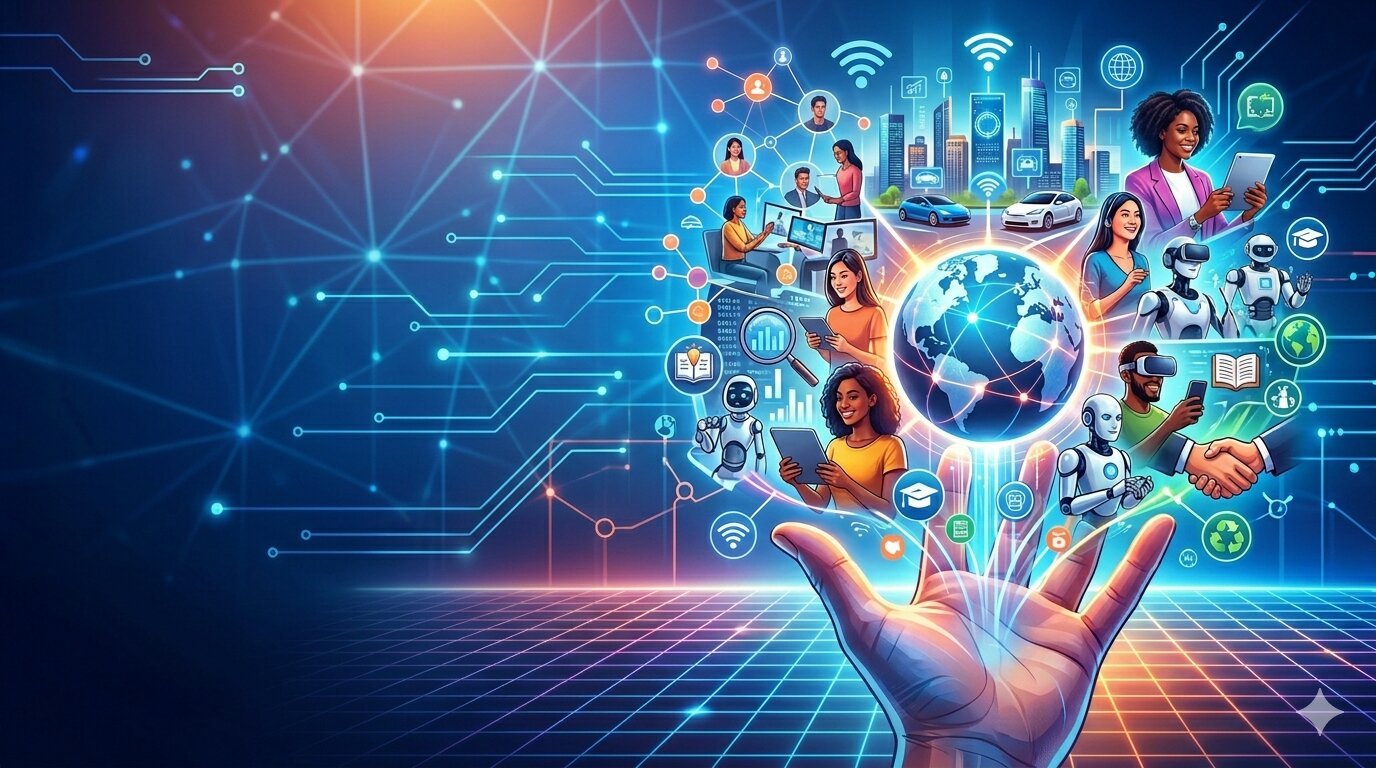
What Is The Impact of Technology on Society? It is hard to imagine civilization without technology: people have evolved from primitive tools to quantum computers. But now the pace of change has accelerated to the max. The internet and mobile communications have revolutionized the world before our eyes, affecting everything from work to personal relationships. It is time to explore how technological advances are transforming reality around us and why new opportunities always come hand in hand with new challenges.

The Evolution of the Technological Landscape: From Industrialization to Digitalization
To understand what is happening today, it is worth looking back. The first industrial revolution transformed the physical world: people learned to replace manual labor with machines, mastered electricity, and built factories. This drove people from villages to cities and created the world as it is known today. Then, in the second half of the last century, came digital electronics and the first computers.
Today, people are in the midst of the Fourth Industrial Revolution. Its main difference is that the boundaries between reality, digital code, and biology are virtually erased. It is not about any one technology. AI, robotics, 3D printing, and quantum computers do not work in isolation; they intertwine:
- Synergy. Nanotechnology helps develop biotech, and AI accelerates calculations in materials science.
- Speed. This process feeds on itself, driving progress exponentially.
People are forced to adapt to these changes as we go. And, normally, such a pace evokes not only delight, but also a completely understandable fear of the unknown future.
Transformation of Communications And Social Connections
Modern technology has achieved a key result: connecting people working in different parts of the world. It’s now possible not only to communicate, but also to work on large projects, even if they are located far apart. This has become part of globalization, something people could only dream of before, and so social media and messaging apps have become a much more important achievement than might initially seem. Among the several advantages of modern technology, it’s worth noting:
- Speed. We no longer wait weeks for emails. Messages arrive in a split second, and this has become a norm we barely even notice.
- Erasing boundaries. Working in an international team or being friends with someone from another country has become commonplace.
- Everyone is their own media. You do not need to be a TV presenter to be heard by millions anymore. A smartphone and internet access are enough.
- Flexibility. Asynchronicity is a lifesaver. You respond when it is convenient for you, not when the phone rings.
- Emotions in digital form. Images, memes, and videos make correspondence feel alive, albeit virtual.
There are also nuances associated with the desire to achieve greater efficiency. Being constantly at the center of information noise creates FOMO, a fear of missing out on something. Furthermore, the anonymity of the internet contributes to so-called cyberbullying, made possible by the advent of social media.
At the same time, a feeling of loneliness online is also noticeable. Despite the ability to communicate with virtually anyone, regardless of where they live, most people still feel lonely. The main challenge for society in this case is maintaining a connection to reality while being online.
Impact on the Economy – Automation and New Markets
The global economy is changing so rapidly that it feels more like a storm than just evolution. While IT was once a useful tool, today it is the foundation of any business. Robots and algorithms are no longer confined to machine tools – they have confidently entered white-collar territory. Today, neural networks seamlessly review contracts, make diagnoses, and write code that until recently seemed pure science fiction.
Two Sides of the Coin
Of course, there are many advantages: companies are working faster, goods are becoming cheaper, and services are becoming more convenient. Entire markets have emerged that we never dreamed of before. But there is also a downside – the risk of being left behind. Professions tied to routine tasks, data entry, or simple mediation are literally disappearing before our eyes.
| Feature | Industrial Era | Digital Reality |
| Core Resource | Raw materials, factories, and physical labor | Data, knowledge, and intellect |
| Work Environment | Strict hierarchy, fixed office, or shop floor | Agile teams, remote work, gig economy |
| Pace of Change | Gradual, measured in decades | Exponential, measured in months |
| Scalability | Requires heavy capital to grow | Near-zero marginal cost for copying products |
| Human Role | Task executor following instructions | Creator, analyst, and «algorithm manager» |
Platforms like Uber and Upwork have given us freedom. Millions of people decide for themselves when to work and what projects to take on. But this comes at a price. People are accustomed to the benefits, vacations, and pensions guaranteed by classical 20th-century capitalism. Freelancers do not have these things. Society now needs to rethink what «work» means and how to protect individuals in a world where the old rules no longer apply.
The Entertainment And Leisure Industry In The Digital Age
The entertainment industry is adapting to technology faster than anyone else for one simple reason: it is a real-time war for our attention. The era of CDs and vinyl is well and truly over – Netflix and Spotify have accustomed us to the «everything at once» model. Now people do not rummage through music, but lazily listen to whatever algorithms throw at them. Because technology knows people’s tastes frighteningly well, analyzing every click and every missed track.
Games as an Engine of Progress
In fact, gamers are the main culprits behind our computers being so powerful. If it were not for their graphics demands, people would still be stuck with weak hardware. Games have long ceased to be mere shooters – they are entire universes with their own economies and social hierarchies. And what about esports? These are not just basement get-togethers anymore, but packed stadiums and budgets that would make professional football players wide-eyed.
A World Without Borders
Digitalization has completely erased the concept of «local». It does not matter where the server is physically located. For example, sites like Win Bet online (Bangladesh) clearly demonstrate how easily technology transcends borders. It doesn’t matter where you are: New York City or Dhaka – you log in and play. But behind this ease lies a hell of a lot of work for developers: they need to protect their data and ensure the interface does not lag even on an old budget smartphone that’s long overdue for the bin.
The Attention Economy: The Dopamine Trap
The bottom line is that our attention is simply being traded. Social media and app developers are not just coding; they are using dirty hacks from neuroscience. All those likes, endless feeds, and push notifications are designed to feed us dopamine. People are literally hooked, and then you find yourself at 3 AM scrolling through your feed, even though you only came in for «five minutes».

A Revolution In Medicine And Healthcare
The impact technology has on medicine cannot be ignored. IT and biotech have increased life expectancy and quality of life. While genome sequencing previously required years and millions of dollars, it can now be done in just a few days, making the procedure affordable for thousands of patients. This has opened up opportunities for more personalized medicine, dramatically increasing the effectiveness of treatments for cancer and rare genetic diseases.
Another technology that has become very important for the meds – AI, as it helps in making diagnostics much easier and faster. Computer vision algorithms can analyze X-rays, MRIs, and biopsy results faster and often more accurately than a team of experienced doctors. This technology also accelerates the drug development process by modeling the interactions of millions of molecules and predicting their effectiveness, shortening the time it takes for a drug to reach the pharmacy from decades to just a few years.
Wearable gadgets should not be forgotten, as they help people to focus on their health. Doctors can monitor the activity of their patients and find new ways to help them quickly, whenever they need it. This is especially important for people living in remote areas or those with chronic illnesses. Innovations in 3D printing make it possible to create customized implants and prosthetics, and in the future, promise to solve the shortage of donor organs through bioprinting of living tissue.
Education – From Standardization to Personalization
Our education system is a throwback to the factory era. Previously, everyone was taught using the same template so they could work smoothly at a machine or in an office. But now this approach is simply crumbling. Thanks to the internet, knowledge is no longer scarce. Today, a kid from the sticks can easily take courses at Harvard or MIT and gain the same foundation as students in Boston. That is true democracy.
Of course, the 2020 pandemic gave us all a powerful push toward digital. We were literally forced to go online. And this experiment showed that EdTech is cool, but far from perfect. The main stumbling blocks in digital learning:
- The opportunity gap. While one person has a top-of-the-line MacBook and gigabit internet at home, another is struggling to find a connection on an old phone. The digital divide is a real problem.
- Where can people find motivation? Learning on your own without a stern teacher nearby is a challenge. Most people simply abandon courses halfway through.
- Loneliness in front of a screen. People go to university not only for lectures, but also for social interaction. Soft skills and team spirit are only just barely developed via Zoom.
- Information noise. There’s so much data that the brain simply switches off. People become accustomed to scrolling rather than delving into the essence.
Simply buying tablets for schools is not the answer. People need to change the very nature of teaching. Teachers should no longer be «talking heads»; their job is to become mentors and help students avoid drowning in a sea of information. AI algorithms will likely soon begin to assist us, tailoring the curriculum to the pace of each student. But it’s important to remember: technology is only a tool, not a substitute for a genuine interest in learning.

Ethical Challenges And Privacy
Technology is rushing into our lives so quickly that we simply cannot keep up with the development of adequate laws for it. Today, data is the new oil. Literally every click, like, or navigation route you take is being turned into a commodity. People have become accustomed to clicking «I agree» under huge terms and conditions without even looking, essentially handing over our digital identities to corporations. And this is no longer just a matter of convenience, but a matter of real privacy.
The Problem of «Crooked» Learning
Another issue is algorithmic bias. AI does not get ideas from outer space; it learns from us. If the data it was trained on contained human biases, the neural network would simply copy them. Ultimately, when an algorithm decides who to give a loan to or hire, it can simply automate good old injustice, only on a national scale.
The Era of Fakes and Control
Deepfakes hit where it hurts most: trust. When the face or voice of any politician or businessman can be faked, distinguishing truth from fabrication becomes nearly impossible. Fake news on social media already spreads far faster than the truth, and now it’s also a tool for blackmail and election manipulation.
Against this backdrop, cities are being swamped with facial recognition systems. People are told it is for security, but in reality, people are walking a fine line. One wrong move, and the «safe environment» turns into digital authoritarianism, where your every move is monitored in real time.
Technologies are neutral. Their ethical connotations depend solely on their intended use. The main challenge today is to direct progress toward the benefit of society as a whole, not a handful of corporations. People vitally need digital literacy and an ethical filter for any innovation. To preserve dignity and freedom, people must learn to manage innovation consciously. This is the only chance to build a sustainable and fair future.